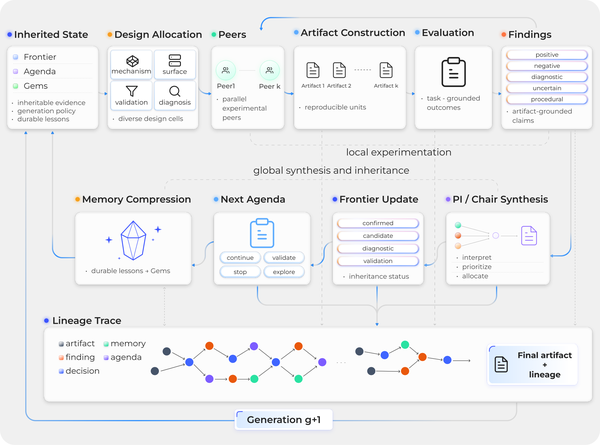
Praxist is an autonomous AI-scientist framework that turns reproducible experimental artifacts into an evidence graph of solution lineages, so that agents can inherit validated mechanisms across attempts and every gain can be traced to its cause.
@article{li2026praxist,title={Praxist: From Experimental Artifacts to Solution Lineages},author={Li, Jin and Murtadha, Ahmed and Wang, Zhiyu and Chen, Qiwen and Chen, William and Wu, Yifei and Wang, Guan and Siy, Andy L. and Yang, Jiayi and Huang, Mengsha and Li, Wenhao and Liu, Yixuan and Pan, Shuailin and Yuan, Mingli and Song, Sen and Sun, Yuhao},year={2026},eprint={2608.25955},archiveprefix={arXiv},primaryclass={cs.MA},github={sapientinc/PRAXIST},}
IEEE CEM
Data-Efficient AU-Graph Transfer Learning for Consumer-Camera Pain-Aware Sensing
Zhiyu Wang, Han Wei Wang, Hangqian Li, and 3 more authors
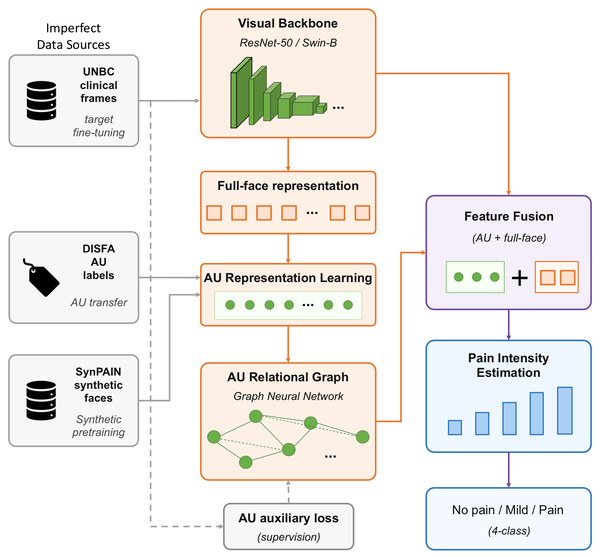
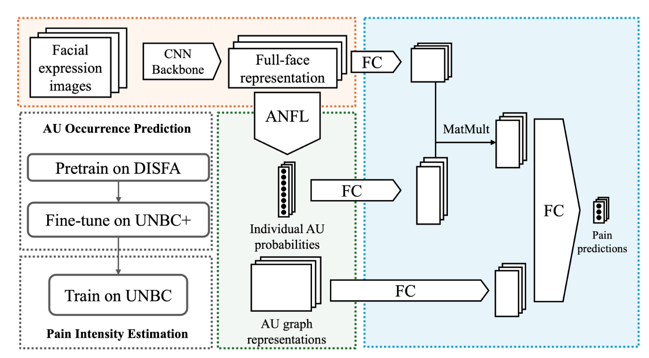
GraphAU-Pain++ is a data-efficient AU-graph transfer learning framework for pain-aware sensing with consumer cameras. It transfers structured facial action unit (AU) knowledge from DISFA, uses synthetic pretraining to add pain-related and demographic variability, and adapts to a small target domain with auxiliary AU-graph supervision, giving interpretable intermediate representations under imperfect data.
@article{wang2026cem,title={Data-Efficient AU-Graph Transfer Learning for Consumer-Camera Pain-Aware Sensing},author={Wang, Zhiyu and Wang, Han Wei and Li, Hangqian and Jiang, Jun and Gunes, Hatice and Liu, Yang},year={2026},journal={IEEE Consumer Electronics Magazine},doi={10.1109/MCE.2026.3723599},}
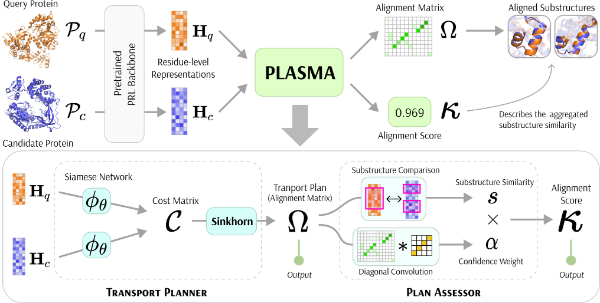
PLASMA is a module based on optimal transport that can be seamlessly added to any protein representation learning model with minimal training or even no training to enable fast and highly accurate identification of locally similar substructures. In detecting shared substructures (motifs, binding sites, and active sites), PLASMA reaches ROC-AUC 0.96-0.99 versus 0.81-0.93 for the widely used global aligner TM-align at about 50x its speed, and outperforms the state-of-the-art local method EBA at about 3x its speed, with much cleaner alignments.
@inproceedings{wang2026plasma,title={Fast and Interpretable Protein Substructure Alignment via Optimal Transport},author={Wang, Zhiyu and Zhou, Bingxin and Wang, Jing and Tan, Yang and Zhao, Weishu and Li\`o, Pietro and Hong, Liang},year={2026},booktitle={International Conference on Learning Representations (ICLR)},eprint={2510.11752},archiveprefix={arXiv},primaryclass={q-bio.BM},github={ZW471/PLASMA-Protein-Local-Alignment},note={Poster}}
2025
arXiv
Topotein: Topological Deep Learning for Protein Representation Learning
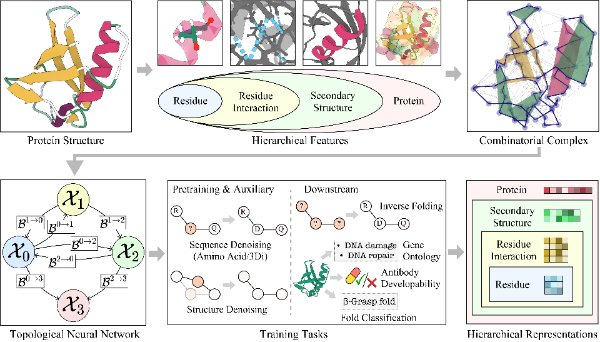
Topotein is a complete SE(3)-equivariant framework that adds a secondary-structure level to protein representations via a hierarchical hypergraph, the Protein Combinatorial Complex (PCC), processed by the Topology-Complete Perceptron Network (TCPNet). This coarser-grained view gives a better global understanding of protein structure, achieving the best SCOP fold classification accuracy (43.3%, vs. 38.4% for the same network without the hierarchy).
@article{wang2025tcpnet,title={Topotein: Topological Deep Learning for Protein Representation Learning},author={Wang, Zhiyu and Jamasb, Arian R. and Hajij, Mustafa and Morehead, Alex and Braithwaite, Luke and Li\`o, Pietro},year={2025},eprint={2509.03885},archiveprefix={arXiv},primaryclass={cs.LG},github={ZW471/TopoteinWorkshop}}
arXiv
MoRE-GNN: Multi-omics Data Integration with a Heterogeneous Graph Autoencoder
Zhiyu Wang*, Sonia Koszut*, Pietro Liò, and 1 more author
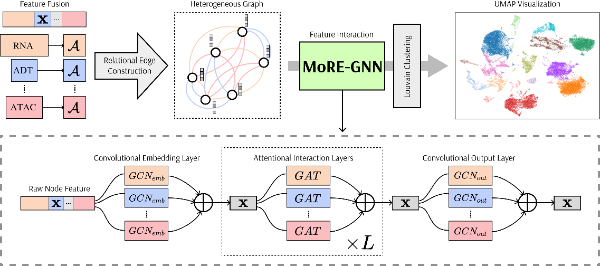
MoRE-GNN is a heterogeneous graph autoencoder that combines graph convolution and attention mechanisms to dynamically construct relational graphs directly from single-cell multi-omics data (e.g. RNA, protein, and ATAC modalities), embedding them into a shared latent space for cell clustering. Evaluations on six publicly available datasets demonstrate that MoRE-GNN captures biologically meaningful relationships and outperforms existing methods.
@article{wang2025multiomics,title={MoRE-GNN: Multi-omics Data Integration with a Heterogeneous Graph Autoencoder},author={Wang, Zhiyu and Koszut, Sonia and Li\`o, Pietro and Ceccarelli, Francesco},year={2025},eprint={2510.06880},archiveprefix={arXiv},primaryclass={cs.LG},}
Understanding pain-related facial behaviors is essential for digital healthcare in terms of effective monitoring, assisted diagnostics, and treatment planning, particularly for patients unable to communicate verbally. Existing data-driven methods of detecting pain from facial expressions are limited due to interpretability and severity quantification. To this end, we propose GraphAU-Pain, leveraging a graph-based framework to model facial Action Units (AUs) and their interrelationships for pain intensity estimation. AUs are represented as graph nodes, with co-occurrence relationships as edges, enabling a more expressive depiction of pain-related facial behaviors. By utilizing a relational graph neural network, our framework offers improved interpretability and significant performance gains. Experiments conducted on the publicly available UNBC dataset demonstrate the effectiveness of the GraphAU-Pain, achieving an F1-score of 66.21% and accuracy of 87.61% in pain intensity estimation.
@inproceedings{wang2025graphaupaingraphbasedactionunit,title={GraphAU-Pain: Graph-based Action Unit Representation for Pain Intensity Estimation},author={Wang, Zhiyu and Liu, Yang and Gunes, Hatice},year={2025},booktitle={IJCAI Micro-gesture Analysis for Hidden Emotion Understanding (MiGA) Workshop},address={Guangzhou, China},eprint={2505.19802},archiveprefix={arXiv},primaryclass={cs.LG},}